
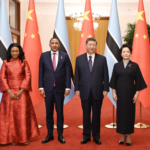



During the General Assembly High-Level debate, the G20 Foreign Ministers convened at the United Nations Headquarters for the first time in history, engaging all 193 UN member states in discussions. The meeting, held on September 25 in the Economic and Social Council (ECOSOC) chamber, focused on global governance reform, hunger, poverty, and sustainable development.
UN Secretary-General António Guterres emphasized the urgency of addressing severe food insecurity, stating, “It is shameful that in our world of plenty, around one person in ten regularly goes without food for an entire day or more.” He praised Brazil’s emphasis on global hunger during its G20 presidency and urged all G20 and UN member states to intensify their efforts to combat this humanitarian crisis.
Guterres also highlighted the need for immediate climate action, asserting that by 2030, global fossil fuel production and consumption must decrease by at least 30%, with renewable energy capacity needing to triple. He called on OECD countries to phase out coal by 2030 and fully decarbonize their power systems by 2035.
South African President Cyril Ramaphosa stressed the importance of reforming the global financial architecture to benefit the most vulnerable populations, warning that failing to act would exacerbate inequality and underdevelopment.
Brazilian President Luiz Inácio Lula da Silva underscored the historic significance of the meeting at the UN, stating, “This was not a trivial decision. It is coherent with our core belief that the United Nations must continue to be the heart of the multilateral system.” He noted the economic disparities, pointing out that in 2022, developing countries paid $49 billion more to foreign creditors than they received, advocating for taxes on the wealthy to combat inequality and fund development and climate initiatives.
The G20 members concluded the meeting by adopting a “Call to Action on Global Governance Reform,” committing to strengthen the multilateral system and modernize key international organizations.