
By Osman Marah
British High Commissioner to Sierra Leone, Josephine Gauld, has said the country could significantly increase its domestic revenue by improving tax collection, warning that substantial amounts of money owed to the state remain uncollected.
Speaking at a press conference at the British High Commissioner’s Residence in Hill Station, Freetown, on Wednesday, 11 November 2026, Gauld said Sierra Leone’s tax revenue collection stood at approximately 8 per cent of Gross Domestic Product (GDP), compared with a regional average of about 15 per cent.
She said closing that gap could unlock significant resources for public services, including education and healthcare, without necessarily introducing new taxes or increasing the burden on existing taxpayers.
The High Commissioner said the UK had been supporting the National Revenue Authority (NRA) through technical cooperation with His Majesty’s Revenue and Customs (HMRC), including the placement of a UK expert within the authority for one year.
She also cited UK-supported property tax reforms, which she said had initially quadrupled some of the revenue collected through improvements in systems and processes.
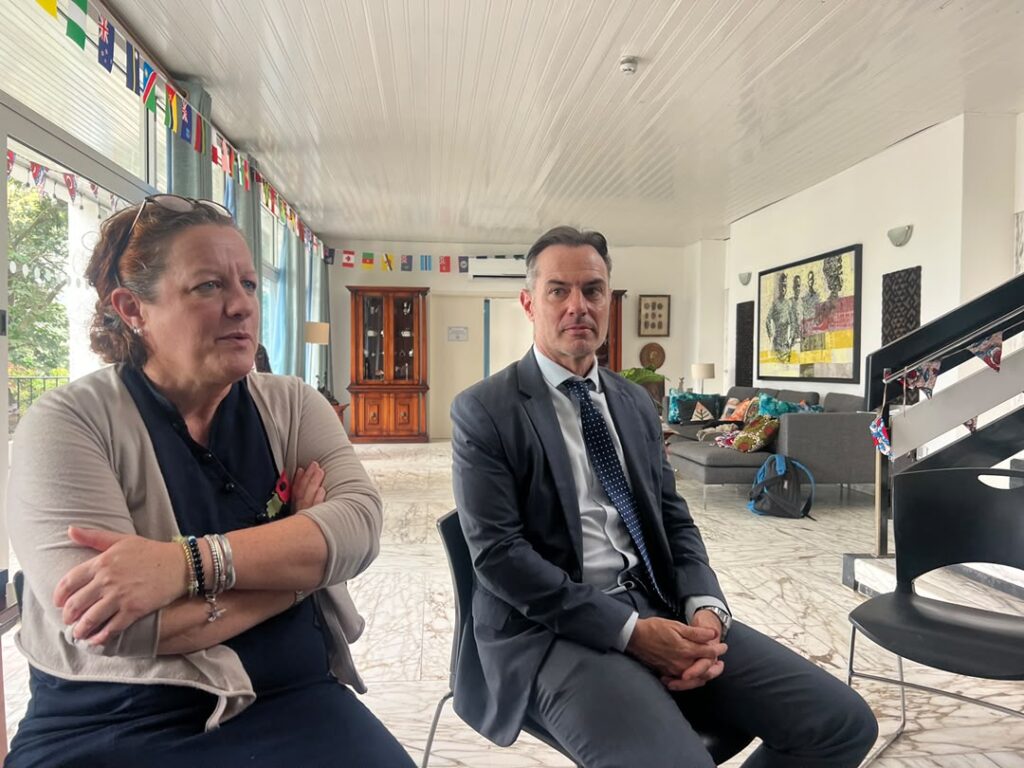
Gauld stressed that the priority should be ensuring that individuals and businesses pay the taxes they already owe rather than imposing additional taxes on those who are complying.
On trade, the UK’s West Africa Trade Lead, Mark Smithsom, disclosed that exports from Sierra Leone to the United Kingdom had increased by 40 per cent over the past year, with bilateral trade also recording overall growth.
He encouraged Sierra Leonean farmers, manufacturers and agro-processing businesses to take advantage of the UK’s Developing Countries Trading Scheme (DCTS), which provides duty-free access for a wide range of products entering the British market.
Mark said approximately 90 per cent of Sierra Leonean exporters to the UK were already benefiting from the scheme, but more awareness was needed to ensure local producers maximize the opportunities.
On healthcare, Gauld disclosed that the UK had completed a programme to install solar power systems in 18 hospitals and 25 health centres across the country, covering every district.
She said the initiative had improved healthcare delivery by enabling medical professionals to perform operations at night without relying on inadequate lighting.
The High Commissioner also confirmed that the UK was working with Sierra Leone’s Ministry of Environment to prepare a proposal for international climate financing aimed at strengthening the resilience of coastal communities.
On the country’s political situation ahead of the 2028 general elections, Gauld acknowledged continuing trust challenges between the governing Sierra Leone People’s Party (SLPP) and the opposition All People’s Congress (APC).
She said recent political developments, including parliamentary proceedings surrounding the constitutional amendment debate, had tested confidence between the two parties.
However, she described the recent meeting between President Julius Maada Bio and former President Ernest Bai Koroma as symbolically encouraging.
Gauld said the UK was closely following the constitutional debate before the Supreme Court, adding that credible democratic institutions and public confidence in the electoral process would be essential to ensuring peaceful elections in 2028.
The remarks were made during a press conference ahead of the British High Commission’s King’s Birthday celebration scheduled for Thursday, 12 November.